In the tribune Zone Expos
The Bronfman Project, Project Peanut and the return of the Expos to Montreal
13 sept. 2026 · 97 vues
For several years, the return of the Expos to Montreal seemed destined to happen through an unusual formula: sharing a baseball team with Tampa Bay.
The project was led in Montreal by Stephen Bronfman, son of Charles Bronfman, the founding owner of the Expos in 1969. Alongside him was a particularly solid group of Quebec entrepreneurs.
The idea progressed enough to gain initial support from Major League Baseball, identify a sector to build a stadium in Montreal and begin discussions with governments.
Then, in January 2022, everything stopped.
The MLB itself ended the "sister cities" project, closing the door on a team that would have shared its season between Tampa Bay and Montreal.
Four years later, Montreal is back in the conversation.
This time, it's no longer about a half-team. With a potential MLB expansion to 32 franchises on the horizon, the Project Peanut is trying to prepare Montreal for something the city hasn't had since 2004: its own major league baseball team.
The Bronfman group first wanted a complete team
Stephen Bronfman's project wasn't born with the idea of sharing the Rays.
For several years, his group had been working on different possibilities to bring a permanent franchise back to Montreal.
And Bronfman wasn't alone.
The Montreal Group notably brought together Pierre Boivin, former president of the Montreal Canadiens, Alain Bouchard, founder of Couche-Tard, Mitch Garber, Eric Boyko, founder of Stingray, and Stéphan Crétier, founder of GardaWorld.
In other words, Montreal had managed to bring together around the same table several Quebec entrepreneurs with considerable business experience and significant financial resources.
The group had also commissioned a market study to measure Montreal's capacity to host major league baseball again.
The conclusions were encouraging.
The study notably estimated that Montreal had a population, a pool of businesses and a media market sufficient to support a franchise. A survey of nearly 14,000 people had also demonstrated significant interest in the return of a team.
But one condition kept coming up: the stadium had to be located near downtown and easily accessible by public transit.
The Peel Basin as the new home of the Expos
The Bronfman group had identified the Peel Basin area, near downtown, as the preferred location.
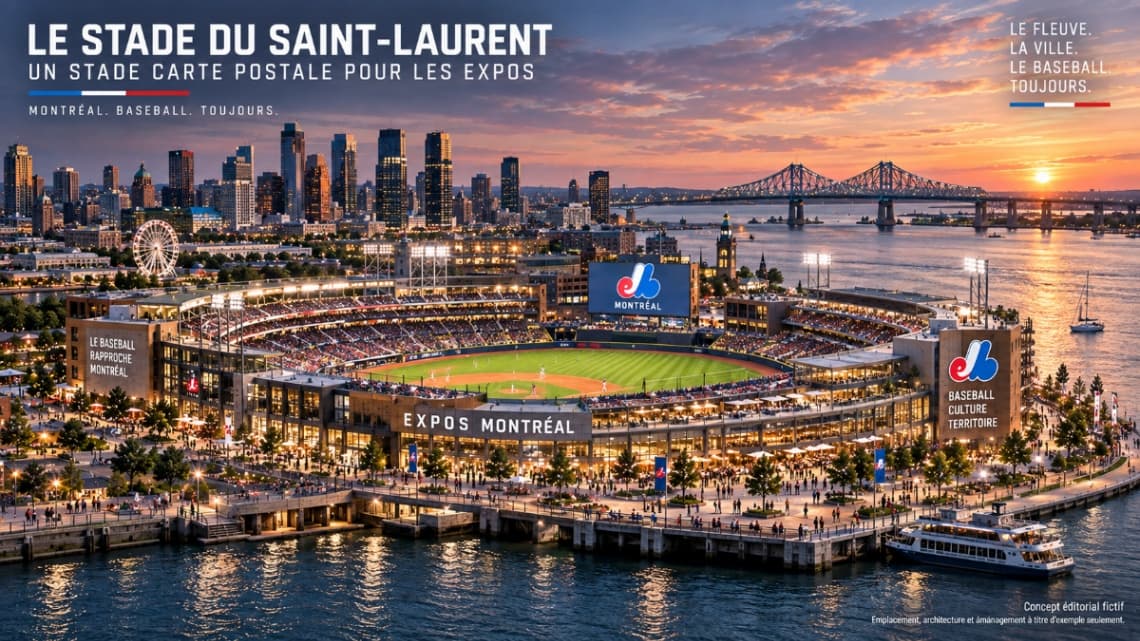
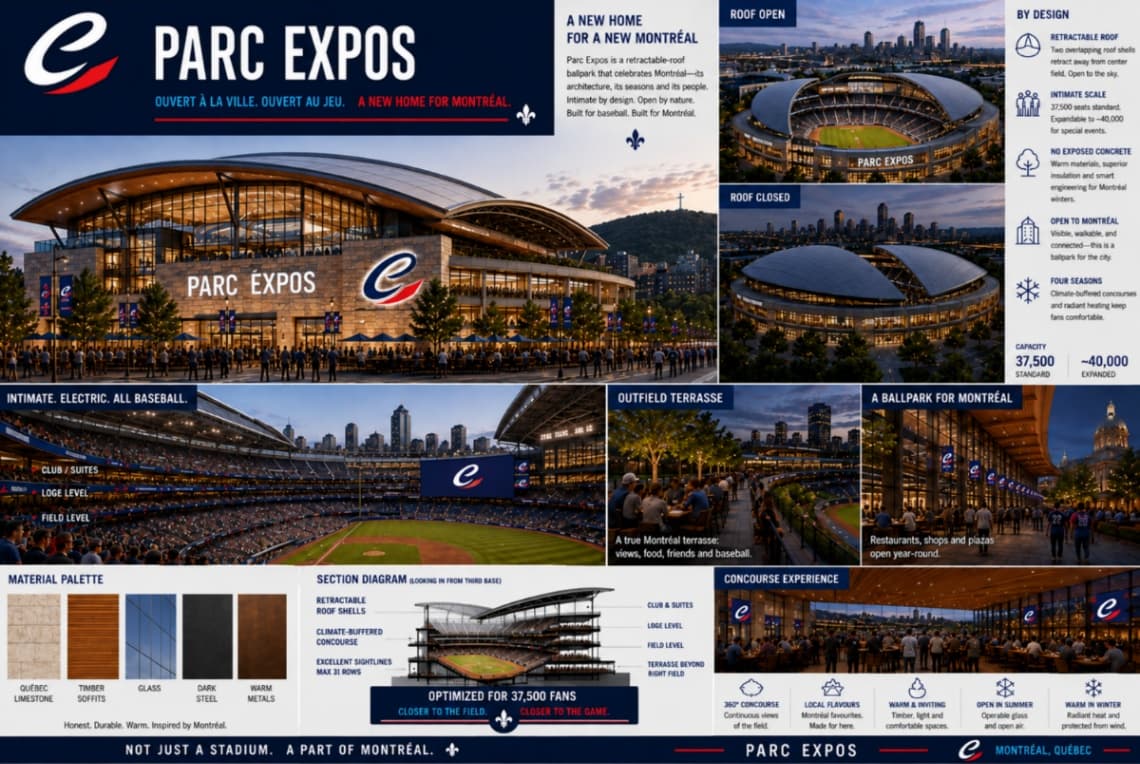
The concept called for an open stadium of approximately 30,000 seats integrated into a much larger development.
The idea already resembled what we find today around several new North American sports projects: the stadium was to become the engine of a neighbourhood featuring retail, offices, public spaces and other year-round activities.
Baseball was therefore only part of the real estate project.
The proximity to downtown and the future Metropolitan Express Network was also a central element of the strategy.
But there remained a major problem: obtaining a team.
Then the Rays entered the picture
In Tampa Bay, the Rays had long lived with a different problem.
Despite their success on the field, the team struggled to attract enough fans to Tropicana Field and was looking for a long-term solution for its stadium.
It was in this context that an extremely unusual idea emerged: one franchise, two cities and two stadiums.
In June 2019, the MLB authorized the Rays to officially explore this possibility.
The scenario called for the team to start its season in Florida before playing a significant portion of its summer schedule in Montreal.
Each market would have had its own outdoor stadium.
The idea theoretically allowed the Rays to benefit from two markets while reducing infrastructure costs. The weather also made the formula attractive: Florida in spring and Montreal during warmer months.
For Montreal, it was obviously not the complete return of the Expos that many fans dreamed of.
But it was major league baseball.
And most importantly, it was a foot in the door.
A half-team to eventually get something better?
The formula has always provoked mixed reactions in Montreal.
For some, accepting a team for only part of the season amounted to acknowledging that Montreal was no longer capable of supporting a franchise on its own.
For others, it was a pragmatic way to get back into the MLB.
Once a stadium was built, a client base developed and the Montreal market proven, nothing prevented imagining that one day Montreal could become a year-round baseball city again.
Even Stuart Sternberg, then principal owner of the Rays, acknowledged that the initial results presented by the Montreal group were encouraging.
The project was therefore moving forward.
Sites had been studied in both markets. Stadium concepts had been developed. Bronfman was discussing with Quebec City and Montreal.
For more than two years, the idea of a Tampa Bay–Montreal team went from the status of an unlikely scenario to that of a genuine project being studied by the MLB.
The MLB itself ends the project
The reversal came on January 20, 2022.
The executive committee of Major League Baseball informed the Rays that it would not after all authorize the sister cities project.
The decision was all the more brutal because the MLB had given permission in 2019 to explore this formula.
After more than two years of work, the project was dead.
Stephen Bronfman publicly acknowledged his deep disappointment. His group had worked on the stadium, financing, real estate development and relationships with various levels of government.
But without MLB approval, there was no project.
The return of the Expos seemed once again postponed for an indefinite period.
Yet all that work was not in vain
This is probably the most interesting aspect when looking at Project Peanut today.
The Bronfman group didn't bring back the Expos, but it helped answer a fundamental question: Can Montreal still be a major league baseball market?
The various studies conducted over the years demonstrated that a potential market exists.
The business community mobilized.
Major investors agreed to publicly associate themselves with the project.
The MLB held serious discussions with Montreal.
Thousands of fans filled Olympic Stadium for preparatory games by the Blue Jays.
And a genuine stadium project was studied.
All this is now part of Montreal's file.
The problem with the Bronfman project was therefore not necessarily Montreal.
It was largely the formula chosen to bring baseball back there.
The context is very different today
The MLB situation has changed considerably since 2022.
The Athletics have left Oakland and their stadium project in Las Vegas is progressing. The situation of the Rays has also changed, and the question of sharing with Montreal is no longer part of the solutions being considered.
Most importantly, Commissioner Rob Manfred has been talking for several years about eventually expanding the MLB from 30 to 32 teams.
This change is fundamental for Montreal.
An expansion means it would no longer be necessary to wait for an owner to decide to relocate their team or invent an unusual formula like the sister cities arrangement.
Two new franchises could be created.
And Montreal could directly try to get one.
As of 2026, no official expansion process has been launched yet. The MLB must notably get through the next collective bargaining negotiations and continue clarifying the stadium situation for certain franchises.
But the scenario of a 32-team league is now serious enough that several cities are preparing.
Nashville, Salt Lake City, Portland, Orlando, Charlotte and other markets are already working to position themselves.
Montreal will therefore not be alone.
Project Peanut picks up the torch
This is precisely the context in which Project Peanut arrives, led by Montreal entrepreneur Ashkan Karbasfrooshan.
The strategy differs from the Bronfman project on one essential point: the objective is a full-time Montreal franchise.
Not 40 games.
Not a shared team.
A genuine MLB franchise based in Montreal.
Karbasfrooshan is working to bring together the investors and executives needed so that a Montreal group is ready when the MLB eventually opens its expansion process.
The project has also surrounded itself with people having direct experience in professional sports, notably former Dodgers general manager Dan Evans for the baseball side.
And work on the stadium has already begun.
In September 2026, Project Peanut launched a request for proposals for land to identify different Greater Montreal sites capable of hosting a stadium and mixed-use real estate development.
In a way, the new group is therefore revisiting several questions that Bronfman had already tried to answer: who will finance the team? Where will it play? What real estate model can make the project viable? And how to convince the MLB?
Does Montreal really have a chance?
Yes.
But having a chance and being a favourite are two very different things.
Montreal has several important arguments.
The metropolitan region has more than four million residents. The city has a unique history with the Expos and a brand that remains known internationally. Quebec also offers a population base that would allow a team to represent much more than just the Island of Montreal.
The work done by the Bronfman group also demonstrated the existence of corporate interest in major league baseball.
And Montreal would bring something particular to the MLB: a second Canadian market, a unique French-speaking identity and a natural rivalry with Toronto and several teams in the northeastern United States.
But the competition will be fierce.
American groups interested in expansion also have investors, stadium projects and significant political support.
The MLB won't simply choose the two cities that love baseball the most.
It will choose the two projects that offer the best combination of owners, stadium, market, revenues and growth potential.
This time, Montreal must be ready before the door opens
This is probably the greatest lesson from the Bronfman project.
Montreal cannot wait for the MLB to officially announce its expansion before starting to look for investors or land.
When the process begins, competing cities will have already done much of the work.
This is exactly what Project Peanut is trying to do.
Identify the land now. Bring together investors now. Build the financial model now. Recruit executives now.
That way, if the MLB officially opens the door to two new franchises, Montreal can present something more than a nostalgic wish to see the Expos again.
It can present a genuine project.
From shared custody to a real second chance
The Bronfman project ended brutally in January 2022, but it may have been a necessary step on the long road back to major league baseball in Montreal.
It demonstrated that major Quebec investors were willing to take an interest in baseball. It made it possible to test the market. It forced reflection on a new stadium. And most importantly, it brought Montreal back into Major League Baseball discussions nearly twenty years after the Expos left.
Project Peanut now arrives in a potentially much more favourable context.
For the first time in a long time, Montreal might not need to acquire a struggling team or share a franchise with another city.
If the MLB truly expands to 32 teams, two new spots will be available.
Nothing guarantees that Montreal will get one.
Project Peanut still needs to bring together sufficiently capitalized owners, find the right land, propose a financially realistic stadium and demonstrate to the MLB that a Montreal franchise can thrive for decades to come.
But unlike the sister cities project, the objective is now clear.
It's no longer about finding a way to bring some major league baseball back to Montreal.
It's about bringing back the Expos.